
The Innovation code : Process
Part II : Unlock the process code to be Systematically Inventive

If you haven’t checked out Part I, please check it out: “The Innovation Code: Traits”.
From Fuel to Function
In Part I, we explored the essential traits that fuel the innovation engine. However, a powerful steam engine needs more than just fuel; it requires a sturdy train to translate that energy into a successful journey.
Think of it this way: your traits are the high-quality coal that fuels your steam engine of creativity. But without a well-defined process—the train to carry your ideas forward—that fuel can't be effectively utilized. A robust process acts as the train, helping you harness the potential of these traits and navigate the path toward systematic, functional innovation.
Consistency Code
Innovation isn't a passive pursuit; it thrives on a structured process – it doesn't magically appear, even in the case of seemingly accidental breakthroughs. The key to unlocking consistent innovation lies in channeling your energy strategically with a specific focus throughout each stage of the process. So, what exactly are these stages, and what makes this Consistency Code effective?
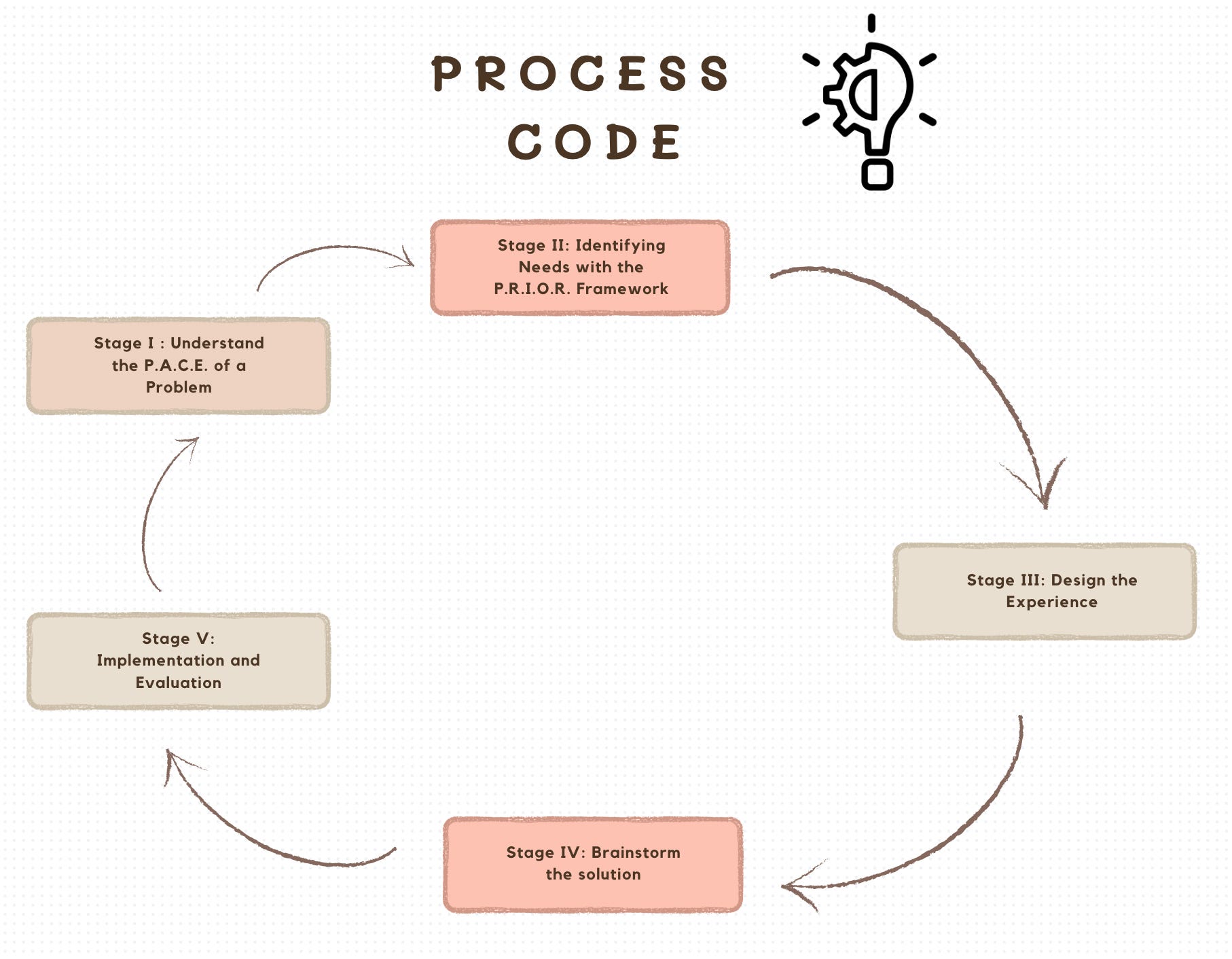
Stage I: Understand the P.A.C.E. of a Problem
Just like a train needs a designated destination to reach, successful innovation requires a clear understanding of the problem you're trying to solve. This first stage focuses on understanding the P.A.C.E. (Performance, Accessibility, Convenience, and Efficiency) of the existing solution.
Think about a product that impressed you with its innovative approach. It likely addressed a problem in one or more of these P.A.C.E. areas significantly better than the previous solution.
Let's consider Microsoft's recently announced Copilot + PCs. Analyzing its features through the P.A.C.E. lens reveals potential improvements:
Performance: Microsoft claims its new Surface Laptop outperforms the MacBook Air M3 in multithreaded workloads by 50%.
Convenience: The new recall feature simplifies information retrieval, making it more convenient than ever.
Efficiency: The battery life promises improved efficiency compared to previous models.
Accessibility: Even Dell announced their partnership in bringing CoPilot+PC and AI PCs is starting to become more accessible than ever before.
This research, when applied to your domain or area of expertise knowing what you know, can help you pinpoint the P.A.C.E. weaknesses that contribute to identifying problems within exisiting solution in your scope of field.
Stage II: Identifying Needs with the P.R.I.O.R. Framework
Following the problem exploration in Stage I using PACE, we now move to Stage II: identifying the most critical needs within the problem space. The P.R.I.O.R. framework becomes our compass, helping us prioritize and focus our innovation efforts on the issues with the most significant impact. Through this framework, we will walk through two different scenarios for identifying the need (see Fig 2):
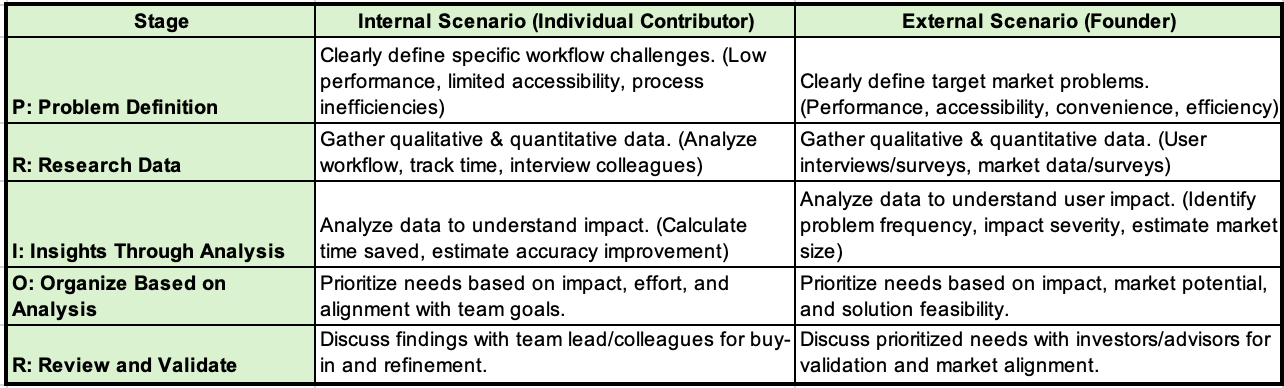
This iterative process ensures you're focusing on areas that will have the most significant impact on users or customers, whether you're innovating internally within an organization or identifying market needs as a founder.
Stage III: Design the Experience
Once you've pinpointed the problem through research (Stage 2), it's time to focus on designing the user experience (UX) before diving straight into solutions. This might seem counterintuitive, but hear me out. The best solutions often emerge from a deep understanding of the desired user experience.
Think of leading companies like Apple, Meta, and Airbnb. They prioritize design-centric approaches. Why? Because design allows them to tackle problems from the user's perspective. While technology plays a role in shaping experiences, the user ultimately cares more about how a product or service makes them feel. Technology, when used with a design-focused approach, amplifies positive user experiences by keeping the user journey at the forefront.
Take Apple, for example. Their design focus is legendary. Despite not having all the features of some Android phones, Apple boasts a dominant market share (around 53.41%). This success hinges on their ability to deliver a stellar user experience. It echoes the famous Maya Angelou quote: "People will forget what you said, people will forget what you did, but people will never forget how you made them feel." Creating a memorable and positive user experience is what truly sets innovative products apart.
Stage IV: Brainstorm the solution
After crafting the ideal user experience (Stage III), the next step involves brainstorming potential solutions to bridge the gap between the problem and the desired experience. This stage isn't about finding the single "perfect" solution; it's about generating a variety of ideas, some potentially unconventional, to explore different approaches. Remember, the user experience should guide the brainstorming process, ensuring solutions are tailored to achieve a seamless and engaging interaction.
Once you have a list of promising solutions, it's time to evaluate their pros and cons. Here's a breakdown of the key considerations:
Pros: What are the advantages of each solution? How well does it address the identified problem and user needs? Does it align with the designed user experience?
Cons: Are there any drawbacks or limitations to this solution? Is it technically feasible or cost-effective to implement? Could it introduce any user experience issues?
By carefully analyzing the pros and cons within the context of your specific situation, you can identify the solution that offers the best balance in terms of business, user, and market needs.
Stage V: Implementation and Evaluation
This stage is where the rubber meets the road – the actual execution of your plan. If the previous steps were done well, you're on the cusp of building something innovative.
Here's what Stage V entails:
1. Execution Strategy:
Solution Breakdown: Break down your chosen solution into smaller, manageable components. This helps with task allocation and prioritization during implementation.
Resource Allocation: Allocate the necessary resources (people, equipment, budget) effectively to ensure a smooth development process.
Streamlined Implementation: Implement the solution in a well-defined and efficient manner.
2. Evaluation and Launch:
Testing Goals: Evaluate the final product against the goals set. This ensures your solution addresses the identified needs.
User Testing: Test the solution with end-users to gather feedback on usability, effectiveness, and overall user experience.
Launch and Monitoring: Once the solution is validated through testing, launch it to the target audience. Continuously monitor its user feedback.
Here's how Stage V feeds into future iterations:
Iterative Improvement: Incorporate user feedback from launch to continuously improve and refine your solution (Reiterate from Stage I – Understand the Problem).
New Problem Prioritization: As your solution evolves, other problems that weren't initially prioritized might now become more relevant. Re-evaluate your problem list and consider tackling new challenges.
These ongoing activities – optimizing the existing product, exploring new problems, and re-evaluating priorities – drive continuous innovation.
Final Thoughts
Think of the innovation process as a train journey. The stronger the execution at each stage , the smoother the ride towards your innovative destination. However, remember that innovation isn't a rigid, linear journey. Just like a train conductor adapts to unexpected situations, you too need to be flexible.
The process framework should be a dynamic tool, constantly iterated upon to fit your specific needs and environment. As Jimmy Dean famously said, "I can't change the direction of the wind, but I can adjust my sails to always reach my destination." Similarly, following a process equips you with the tools to navigate unforeseen challenges and ultimately reach your innovation goals, even if the path itself needs adjustments.
Sources
Thank you for taking the time to read. Feel free to share, comment, and reflect on your perspective. Please let me know if you are interested in learning more about tech, business, and personal growth. This is Dheena’s Newsletter - The Hub for Tech Savvy, Business Minds & Growing You.